Balancing Adobo's Umami for Fat Loss
You're four weeks into a cut, doing everything by the book — chicken breast, broccoli, rice measured to the gram. Then Sunday hits, your mom sets a pot of adobo on the table, and you spend the whole meal negotiating with yourself about the sauce. That negotiation is based on a wrong assumption. Adobo's soy-vinegar-garlic sauce is one of the cheapest things on your plate, calorie-wise. The real math on adobo umami fat loss planning has almost nothing to do with the sauce and almost everything to do with the cut of meat, the oil, and the rice sitting next to it. Once you separate those three things, you stop fearing a dish that's actually working in your favor.
Why the Sauce Gets Blamed for the Wrong Reason
Home cooks treat 'sauce' as a single mental category — thick, glossy, and therefore caloric. That instinct comes from cream sauces and sugar-heavy glazes, not from toyo and suka. Soy sauce and cane vinegar are mostly water, salt, amino acids, and acetic acid. There's no fat in either one, and the carbs are close to nothing.
A tablespoon of regular soy sauce runs about 8-10 calories, 1g of carbs, roughly 1g of protein, and 0g of fat, with around 900-960mg of sodium. Cane vinegar is even lighter — about 3 calories per tablespoon, with sodium near zero. A typical adobo braise for four servings might use a quarter cup of soy sauce and a quarter cup of vinegar total. Split four ways, that's roughly 25-30 calories of sauce per plate.
Compare that to the fat rendered out of pork belly during a 45-minute braise, which can be 150-250 calories per serving depending on the cut, and you see where the actual calorie load hides. The sauce isn't lying to you. Your mental model of what a 'sauce' does calorically is what's off. Once you separate liquid seasoning from rendered fat, you can eat adobo on a cut without guessing.
The Umami Science: Why Flavor Helps You Stay in a Deficit
There's a reason adobo doesn't feel like diet food even when it fits your numbers — umami. Glutamate-rich ingredients (soy sauce, vinegar-marinated meat, bay leaf, black pepper) trigger the fifth taste receptor alongside sweet, salty, sour, and bitter. It's the same mechanism that makes broth-based dishes and aged, fermented foods taste 'full' even at low calorie density.
A study published in the American Journal of Clinical Nutrition by Masic and Yeomans found that umami-flavored foods increased satiety compared to bland versions eaten at matched calorie levels. That's not a minor finding for anyone running a deficit. If a 400-calorie plate of adobo chicken and rice keeps you satisfied longer than a 400-calorie plate of plain grilled chicken, you're less likely to graze afterward, and adherence — not any single meal — is what determines whether a cut works over 8-12 weeks.
This is part of why I tell clients Filipino food is a genuine advantage on a cut, not a constraint to manage around. Vinegar-forward, soy-based, garlic-heavy dishes are built for flavor density at low calorie density. You're not fighting your food culture to hit a deficit — you're using it. For more on how to structure flavor without blowing macros, see how we approached cutting fat without killing flavor across three adobo variations.
Building a Lean Adobo Without Changing the Recipe
You don't need a 'diet adobo' recipe. You need three swaps applied to the one your family already makes.
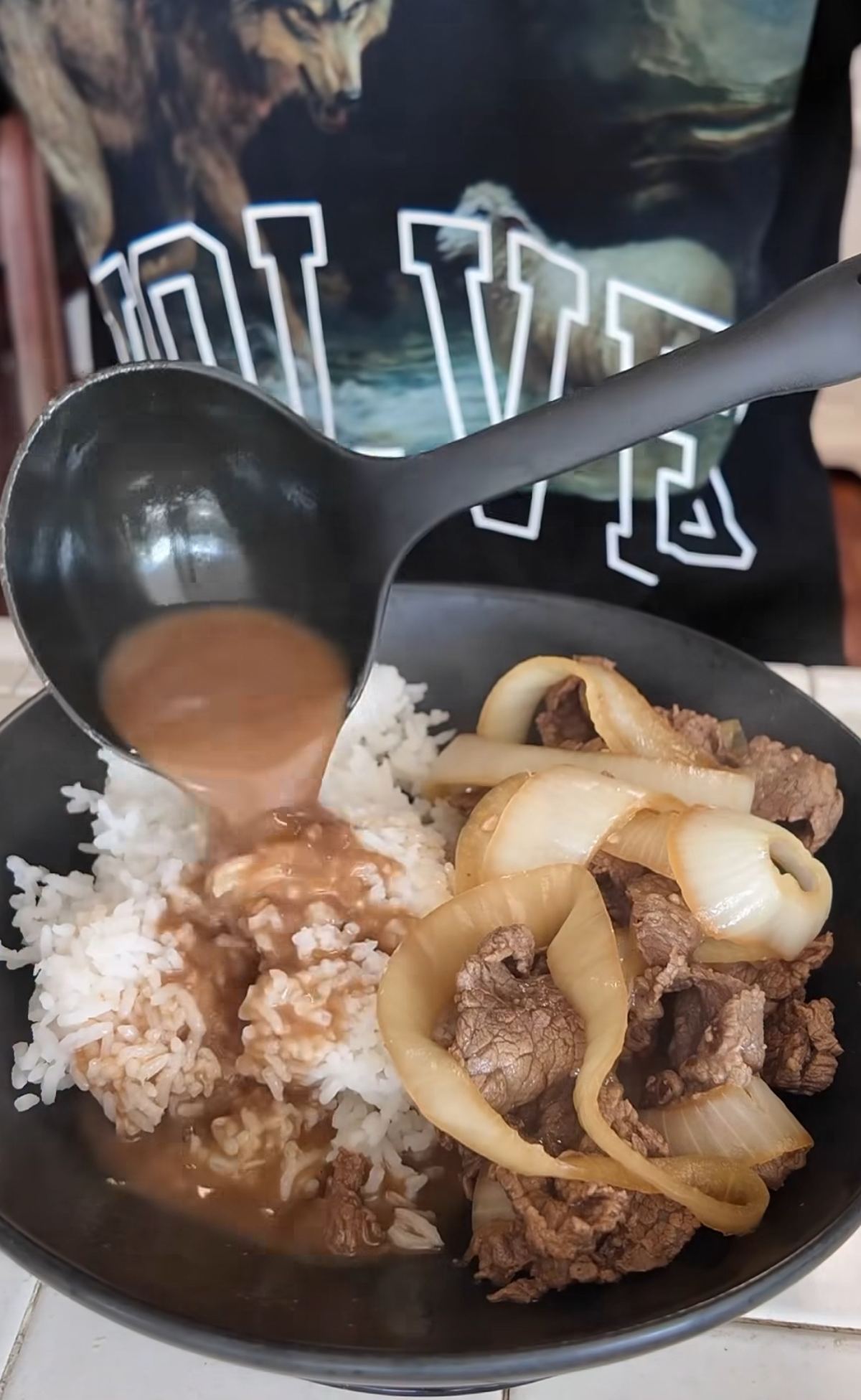
With those three changes, a serving of chicken adobo (150g cooked meat, 2 tablespoons reduced sauce) lands around 290-310 calories with 38-40g of protein and 10-12g of fat. That's a strong number for a cutting meal, and it took nothing away from the dish your family recognizes. The sauce, garlic, bay leaf, and peppercorn stay exactly the same — you're only changing what goes into the pot before the sauce touches it.
Where the Real Calories Hide: Your Rice Portion
If adobo isn't the problem, rice usually is. A level, measured cup of cooked white rice is about 205 calories, 44g carbs, 4g protein, and under 1g of fat. A 'heaping' cup — the kind you get scooping straight from the rice cooker without a measuring cup — can easily hit 300-350 calories. That's a 100-150 calorie gap per meal, and if you eat rice three times a day, that gap alone can erase your entire deficit for the week.
This is the single most common tracking error I see in clients who grew up eating rice at every meal. They track the ulam (the viand — adobo, sinigang, whatever's in the pot) carefully and eyeball the rice, when it should be the other way around. The ulam has natural portion boundaries — a piece of chicken, a scoop of sauce. Rice doesn't, unless you measure it.
Practical fix: keep a 1-cup measuring cup next to your rice cooker for two weeks and use it every time you serve yourself. For most people cutting at 1,800-2,200 calories a day, 1/2 to 3/4 cup of rice per meal (100-155 calories) leaves plenty of room for a full adobo serving and vegetables. I go deeper into the exact math, including how rice timing around training affects the numbers, in the real math on rice and fat loss.
Beyond Adobo: Comparing the Filipino Umami Toolkit
Adobo's toyo-and-suka combo isn't the only low-calorie flavor system in Filipino cooking, and knowing the macro profile of each one lets you rotate flavors without rotating your calorie count.
Rotating between these keeps meals from feeling repetitive on a long cut, which matters more for adherence than any single ingredient's exact calorie count. I covered how to use several of these ingredients specifically for weight loss in five Filipino ingredients that boost umami without the calories.
Sodium: The One Number That Actually Needs Watching
Sodium, not calories, is where Filipino umami sauces deserve real attention. Toyo, patis, and bagoong are all sodium-dense by design — that's what preserves and concentrates flavor in a food culture built around fermentation and salt-curing. A single adobo meal using two tablespoons of soy sauce plus a splash of patis in the vegetables can easily hit 1,800-2,200mg of sodium, which is most of the American Heart Association's daily recommended cap in one sitting.
For fat loss specifically, sodium doesn't add body fat, but it does affect water retention, and that matters if you're weighing in daily and getting discouraged by a scale that jumped 2 pounds overnight for reasons that have nothing to do with fat. Understanding that distinction keeps people from panicking and making bad decisions mid-cut.
The fix isn't cutting sauce to zero — that guts the dish and your adherence with it. Instead, pair sauce-heavy meals with high-potassium sides that help balance sodium's effect on fluid balance: kangkong, saba bananas, kamote, or a simple cucumber-tomato salad. If you're tracking sodium closely for a physique event or a doctor's recommendation, measure your soy sauce with a tablespoon instead of pouring from the bottle — it's an easy habit that keeps a 900mg estimate from turning into a 2,400mg reality.
A Sample Cutting Day Built Around Umami Sauces
Here's what a real day looks like for a client cutting at roughly 2,000 calories with a rice-and-ulam eating pattern, built entirely around sauce-forward Filipino dishes rather than around them.
Breakfast (450 cal, 35g protein): Tapa-style beef sirloin (120g, marinated in soy sauce, garlic, and a touch of brown sugar, pan-seared) with 2 fried egg whites plus 1 whole egg, and 1/2 cup rice.
Lunch (520 cal, 42g protein): Chicken adobo (150g thigh meat, sauce reduced, 1 tsp oil) with 3/4 cup rice and a side of steamed kangkong.
Snack (250 cal, 20g protein): Greek yogurt with calamansi and a drizzle of honey, or a protein shake if you're short on time.
Dinner (580 cal, 45g protein): Sinigang na bangus (fish, tamarind broth, vegetables) with 1/2 cup rice, plus a small bowl of suka't sili for dipping the fish.
That's roughly 1,800-2,000 calories and 140g+ of protein, built entirely on ingredients most Filipino households already keep stocked. For a full week of this laid out with grocery lists, see the Filipino meal prep framework, which walks through batching adobo, sinigang, and tapa for the week in under two hours.
Common Mistakes That Undo Otherwise Solid Meals
Three mistakes show up again and again with clients who are doing almost everything right.
Adding gata (coconut milk) without accounting for it. A quarter cup of coconut milk adds roughly 110 calories and 11g of fat. Ginataang dishes are worth eating, but they need to be logged as a fat source, not treated like a regular sauce. Swap in light coconut milk (half the fat) for everyday cooking and save full-fat gata for occasions.
Letting oil pool at the bottom of the pan. Restaurant and turo-turo versions of adobo often use 2-3 tablespoons of oil per pan, most of which sits at the bottom and gets ladled over the rice. At home, you control this. Skim visible oil off the top of a braise before plating — it's flavor-neutral to remove since the meat and garlic have already absorbed what they need.
Treating the ulam like the flexible part of the meal. People restrict the adobo and eat rice freely, when the opposite makes more sense. Protein and vegetables have a natural ceiling — you physically stop wanting more chicken. Rice doesn't have that same brake, especially with a flavorful sauce over it. Measure the rice first, then build the rest of the plate around it. For a broader framework on managing this trade-off across a whole week of Filipino cooking, see balancing Filipino flavors with macronutrient control.
This Week's Action Step
Cook your next adobo exactly the way your family always has, with one change: swap the protein to skinless chicken thigh or trimmed pork kasim, sauté in 1 teaspoon of oil, and measure your rice with an actual cup instead of eyeballing it. Log that single meal. You'll likely find it lands between 500-600 calories with 35-40g of protein — a number that fits comfortably into almost any cutting target. The sauce was never what was working against you. Prove it to yourself with one plate this week, then build the rest of your meal prep the same way.
Is adobo sauce bad for weight loss?
No. Adobo's base of soy sauce, vinegar, garlic, and pepper is very low in calories — roughly 15-20 calories per two tablespoons of sauce. What raises the calorie count is the fat rendered from pork belly and the oil used to sauté. Build it with chicken thigh or lean pork and the sauce itself barely registers on your macros.
How many calories are in a tablespoon of soy sauce?
Regular soy sauce runs about 8-10 calories per tablespoon, with roughly 1g of carbs, 1g of protein, 0g of fat, and around 900-960mg of sodium. It's a flavor tool you can use generously on a cut without worrying about calorie load.
Does umami flavor actually help with fat loss?
Indirectly, yes. Research on umami taste (Masic & Yeomans, 2014) found that umami-rich foods increased satiety compared to bland versions at the same calorie count. Practically, that means a well-seasoned adobo or sinigang keeps you fuller on a calorie deficit than the same protein eaten plain.
Is patis or bagoong higher in sodium than soy sauce?
Yes, both typically run higher. Fish sauce (patis) can carry 1,200-1,400mg of sodium per tablespoon, and bagoong isn't far behind. If you're using either daily on a cut, balance it with potassium-rich sides like kangkong, saba, or kamote to help offset the sodium load.
What's the biggest mistake people make with adobo on a diet?
Eyeballing the rice, not the sauce. A 'heaping cup' of rice can run 350-400 calories versus 205 for a level, measured cup — a 150-200 calorie swing that has nothing to do with the adobo itself. Measure the rice, not the sauce.
Can I still eat adobo every day while cutting?
Yes, if you control the protein cut and the oil. Use skinless chicken thigh or trimmed pork kasim, sauté in 1 teaspoon of oil instead of a pooled tablespoon, and portion your rice with a measuring cup. Done that way, a serving lands around 380-420 calories with 35-40g of protein.