High-Protein Adobo Recipes for Muscle Gain (Without the Sugar Crash)
Marco messaged me three weeks into his bulk asking why he was crashing every afternoon around 3 p.m. He's a foreman, on his feet all day, eating what he called "a clean bulk" — chicken adobo, two cups of rice, and a Coke at lunch, every single day. On paper he was eating enough. In practice he was falling asleep at his desk by 3:30 and blaming the rice. The rice wasn't the problem. His adobo recipe used a quarter cup of brown sugar and a splash of Coke in the braising liquid on top of the soda he was drinking with the meal. That's a sugar load most people would associate with a candy bar, hidden inside a savory dish nobody thinks to question. Adobo isn't the issue. The version most of us grew up eating is built for flavor and shelf life, not for a lifter trying to add muscle without the energy crash. Fix the recipe, and adobo becomes one of the best muscle-building meals in your rotation — cheap, high in protein, and something you'll actually want to eat five days a week.
The Real Problem With "Bulking on Adobo"
Most Filipino-American guys I coach grew up eating adobo made with pork belly, a heavy pour of soy sauce, cane vinegar, and enough brown sugar to balance the acidity. That's not a criticism — it's a genuinely good braise. The problem shows up when you're trying to hit a protein target and build muscle, because the calorie math on that version skews hard toward fat and sugar instead of protein.
A typical 4-ounce serving of pork belly adobo runs somewhere around 420-480 calories, with only 12-15g of protein and 25g or more of fat. Compare that to the same portion of skinless chicken thigh adobo at roughly 230 calories with 30-32g of protein. You could eat the chicken version twice and still come in under the calories of one pork belly serving, while doubling your protein intake.
This isn't about cutting a beloved dish out of your life. It's about recognizing that "I eat adobo and rice every day" tells me almost nothing about your macros until I know which cut of meat, how much sugar went into the pot, and how much rice actually landed on the plate. Those three variables decide whether adobo is helping your bulk or quietly working against it.
What's Actually in Your Grandma's Adobo
Break down a traditional pot of adobo and you'll usually find pork belly or a mix of pork and chicken, 1/3 to 1/2 cup soy sauce, 1/4 to 1/3 cup cane vinegar, a head of garlic, bay leaves, peppercorns, and — depending on the household — 2 to 4 tablespoons of brown sugar or a few squeezes of banana ketchup for sweetness. Some versions add a splash of Coke or Sprite for color and glaze.
Run the numbers on a 6-serving batch: 2 lbs of pork belly contributes roughly 2,400-2,800 calories and 70-90g of protein total. Split six ways, that's 400-470 calories and only 12-15g of protein per serving. The sugar adds another 90-140 calories to the pot with zero protein, so it's diluting your protein-to-calorie ratio even further.
None of this is a moral failing in the recipe — it's how adobo was designed to preserve meat before refrigeration was common, using salt, acid, and sugar. But if your goal is body recomposition, you're not cooking for shelf-stability anymore. You're cooking for a protein target, and the traditional ratio of ingredients doesn't serve that goal without adjustment.
Where the Sugar Crash Actually Comes From
The crash Marco felt isn't mysterious. Brown sugar and banana ketchup both spike blood glucose fast, and when that spike isn't buffered by enough fiber, protein, or fat relative to the total sugar load, insulin overshoots and you drop into a trough about 60-90 minutes later. That's the wall you hit mid-afternoon. Harvard's Nutrition Source has covered this pattern extensively with added sugars generally — the mechanism isn't unique to Filipino food, it's just hidden inside a savory dish where people don't expect to find 20-30g of added sugar.
Add a can of Coke to the braising liquid — a real trend in some modern adobo recipes — and you've added roughly 39g of sugar to the pot before anyone sits down to eat. Split across six servings, that's still 6-7g of straight sugar per portion on top of whatever the meal already contributed, plus whatever the person is drinking alongside it.
The fix isn't eliminating sweetness. A well-balanced adobo needs some counterpoint to the vinegar's acidity. Cut the added sugar to 1-2 teaspoons for a 6-serving batch, lean on caramelized garlic and a longer reduction time to build natural sweetness and depth, and skip the soda entirely. You'll notice almost no difference in taste and remove close to 90% of the added sugar.
The High-Protein Adobo Blueprint
Three swaps turn any adobo recipe into a muscle-gain meal without changing what makes it taste like adobo: the cut of meat, the sugar, and the soy-to-vinegar ratio.
The research backing a protein-forward approach here isn't complicated. The International Society of Sports Nutrition's position stand on protein and exercise puts the effective range for muscle gain at 1.6-2.2 grams per kilogram of bodyweight per day, spread across 3-4 meals. For a 180-lb lifter (about 82 kg), that's roughly 130-180g of protein daily, or 35-40g per meal. A single 5-ounce serving of the swapped chicken thigh adobo gets you to around 38-40g of protein on its own — most of a meal's target in one dish.
Recipe: Lean Chicken Thigh Adobo (32g Protein a Serving)
This is the version I give clients who want the exact adobo flavor they grew up with but built around a protein number instead of guesswork.
Ingredients (6 servings): 2 lbs boneless, skinless chicken thighs, 1/3 cup low-sodium soy sauce, 1/3 cup cane vinegar, 8 cloves garlic (smashed), 3 bay leaves, 1 tsp whole black peppercorns, 1 tsp coconut sugar or monk fruit sweetener, 1 tbsp avocado oil, 1/2 cup water.
Method: Sear the chicken thighs in avocado oil over medium-high heat until browned on both sides, about 4 minutes per side — don't cook through yet. Remove and set aside. In the same pan, sauté garlic until fragrant, then add soy sauce, vinegar, bay leaves, peppercorns, sweetener, and water. Bring to a boil, then return the chicken to the pan. Cover and simmer 20-25 minutes until the chicken reaches 165°F internally. Uncover for the last 5-8 minutes to reduce the sauce and let it cling to the meat.
Macros per 5-ounce serving: ~230 kcal, 32g protein, 8g fat, 3g carbs. That's a protein-to-calorie ratio most branded "lean protein" products can't touch, and it costs about $1.40 a serving at current chicken thigh prices.
Recipe: Pork Adobo Without the Sugar Bomb
If pork is non-negotiable for you — and for a lot of Filipino households it is — the move is trimming for lean loin or tenderloin instead of belly, and adjusting cook time since loin dries out faster in a braise.
Ingredients (6 servings): 2 lbs pork loin, cut into 1.5-inch cubes, 1/3 cup soy sauce, 1/3 cup cane vinegar, 6 cloves garlic (smashed), 2 bay leaves, 1 tsp peppercorns, 1 tsp coconut sugar, 1 cup water, 1 tbsp avocado oil.
Method: Sear pork cubes in avocado oil until browned, about 3 minutes per side. Add garlic, cook 30 seconds, then add soy sauce, vinegar, bay leaves, peppercorns, sweetener, and water. Bring to a simmer, cover, and cook 30-35 minutes on low heat — loin needs a gentler simmer than belly or shoulder to stay tender without drying out. Uncover the last 10 minutes to reduce the sauce.
Macros per 5-ounce serving: ~245 kcal, 34g protein, 9g fat, 3g carbs. If you want a richer mouthfeel without going back to belly, add one tablespoon of coconut milk to the sauce during the last five minutes — it adds about 25 calories and 2.5g of fat per serving, which is a fair trade for people who find lean pork loin adobo a little dry.
Building a Bulking Plate Around Adobo
Adobo is the protein anchor, not the whole meal. The plate that actually moves the needle on a bulk pairs it with a measured carb source and something raw or fibrous on the side.
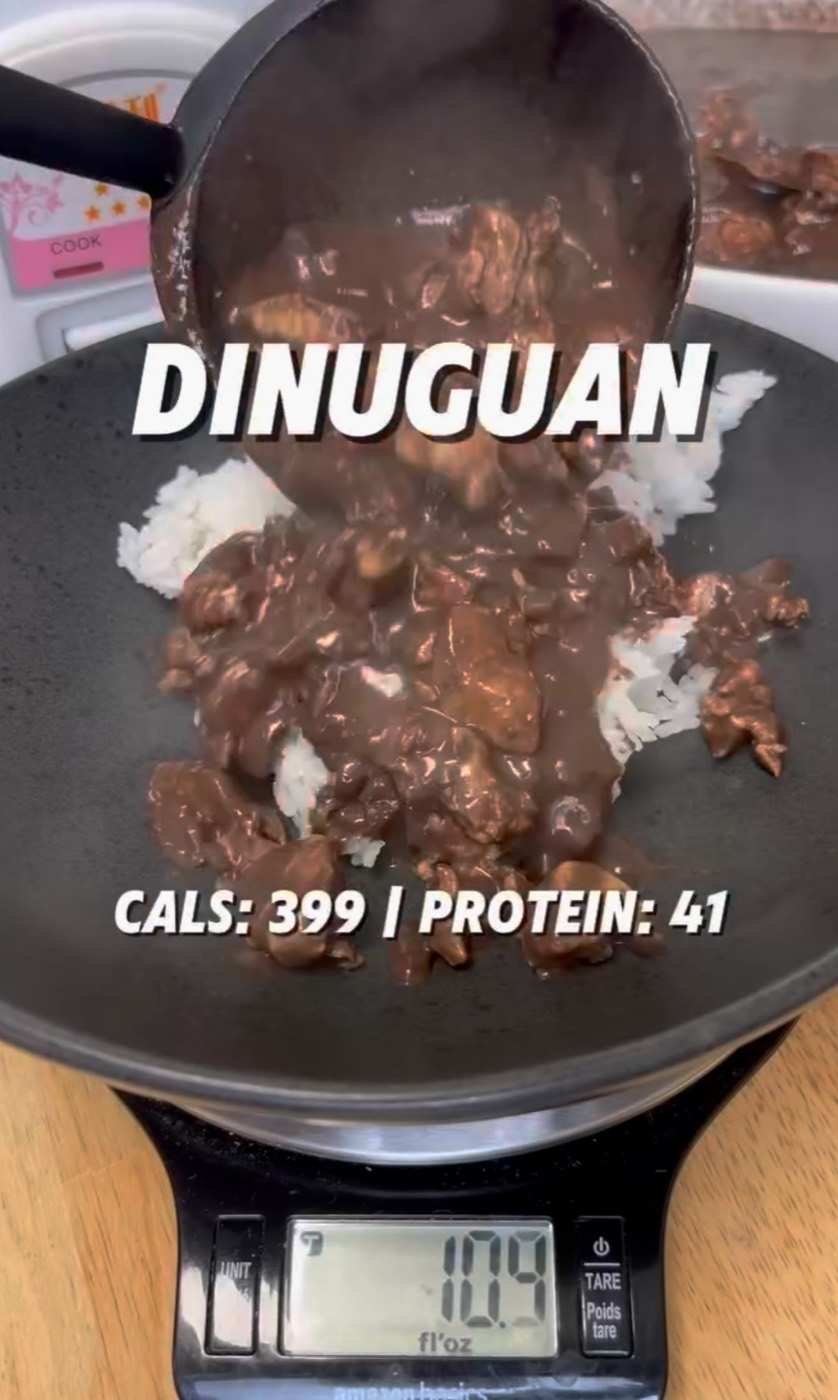
Start with rice measured, not eyeballed. One cup of cooked white rice runs about 200-210 calories and 44-45g of carbs — that's a fixed, known number, unlike a "heaping scoop" that can range anywhere from 1.5 to 3 cups depending on the bowl and the day. Pair that cup of rice with a 5-ounce serving of the chicken thigh adobo above and you're at roughly 430-440 calories with about 36g of protein and 47g of carbs — a clean, trackable bulking meal.
Want more calories for a harder bulk without adding more meat? Add a fried egg (about 90 kcal, 6g protein, 7g fat) or a half-cup of steamed kangkong or bok choy sautéed in a teaspoon of oil (about 40-50 kcal). Both additions push the plate toward 520-530 calories and 42g of protein without touching the sugar content at all.
This is the actual skill of eating for muscle gain on a Filipino-food foundation: it's not a different cuisine, it's the same plate with a measuring cup and a scale involved for two weeks until you know your portions by eye.
Common Mistakes That Kill Your Gains
The biggest one I see is oil creep. Searing meat in a well-oiled pan and then adding more oil "just to be safe" can quietly add 120-150 calories per batch serving with zero nutritional benefit. One tablespoon of oil for searing six servings' worth of meat is enough — you don't need to re-oil the pan between batches.
Second is bottled marinades and pre-made adobo sauces. Many bottled Filipino marinades list sugar as the second or third ingredient, sometimes contributing 8-10g of sugar per two-tablespoon serving. Read the label before you reach for convenience — building the sauce from soy, vinegar, and garlic takes five extra minutes and gives you full control.
Third is inconsistent rice portioning, which I mentioned above but can't overstate. If your rice serving swings from one cup to three cups depending on how hungry you are, your daily carb intake can swing by 400+ calories without you noticing, and that variability is often what stalls a bulk or triggers unwanted fat gain that gets blamed on "the rice" instead of the lack of measurement.
Fourth: skipping the fibrous side. A plate of adobo and rice with nothing green moves through your gut fast and leaves you hungry again in two hours. A half-cup of sautéed greens adds volume and slows digestion for close to zero calorie cost.
Timing Adobo Around Training and Your Move This Week
For muscle gain, total daily protein matters more than exact timing, but there's still a practical case for eating a protein-dense meal like this within two to three hours of training. The chicken thigh version above delivers 32g of protein in a form that digests predictably — no shakes, no guessing about absorption — which makes it a solid post-lift meal alongside your rice and greens.
If you train in the evening, batch-cook adobo on Sunday for the week and portion it into 5-ounce containers with a measured cup of rice. That removes the decision-making at 8 p.m. when you're tired and reaching for whatever's fastest, which is usually the moment old habits — extra rice, a soda, a sweeter sauce — creep back in.
Here's your one action step for this week: cook one batch of the lean chicken thigh adobo above, portion it into six containers with a measured cup of rice each, and eat it as your post-training meal at least three times this week. Track the total protein for those days. If you're landing above 35g per serving without the 3 p.m. crash Marco used to get, you've already fixed the two variables — cut and sugar — that were working against your bulk the whole time.
Is adobo good for muscle gain?
Yes, when you build it around a lean protein source. Chicken thigh or pork loin adobo delivers 30-35g of protein per serving with moderate fat, which fits well into a muscle-gain diet. The traditional version made with pork belly and heavy sugar works against you because the calories come mostly from fat and sugar instead of protein.
How much protein is in chicken adobo?
A 4-ounce serving of skinless chicken thigh adobo runs about 30-32g of protein, roughly 220-240 calories, depending on how much oil is used to brown the chicken. Chicken breast adobo pushes protein closer to 35g per serving with less fat.
Does adobo have too much sugar to eat while cutting or bulking?
Traditional recipes that call for 1/4 cup brown sugar or a few tablespoons of banana ketchup can add 20-30g of sugar to the whole pot. Cut that to 1-2 teaspoons or skip it entirely and rely on caramelized garlic and reduced vinegar for flavor — you lose almost no taste and remove most of the sugar.
What's the best cut of pork for a high-protein adobo?
Pork loin or pork tenderloin. Both run about 24-26g of protein and 5-7g of fat per 4-ounce cooked serving, compared to pork belly's 12-15g of protein and 25g-plus of fat for the same portion. Trim visible fat before braising if you're using shoulder or kasim.
Can I eat adobo every day and still gain muscle without gaining excess fat?
Yes, if you're tracking total calories and protein for the day, not just the one meal. Adobo is easy to batch cook and portion, which makes daily consistency easier than most Western bulking meals. The issue is almost always the sugar and oil added during cooking, not the dish itself.
How many calories are in a cup of adobo with rice?
A plate with one cup of cooked white rice (about 200 kcal) and a 4-ounce serving of lean chicken adobo (about 230 kcal) lands around 430 kcal with roughly 35g of protein. Add a fried egg and you're at 510-530 kcal and 42g of protein — a solid bulking plate.