Fat-Loss Filipino Meal Prep: A 7-Day High-Protein Adobo & Sinigang Plan for Body Recomposition
A client of mine, Marco, 190 pounds, works swing shifts at a machine shop in National City. He told me he'd already tried cutting adobo and sinigang out of his diet because his old trainer said Filipino food was "too heavy" for a cut. Three weeks of grilled chicken and broccoli later, he was miserable, his mom thought he was sick, and he'd lost four pounds — mostly water. We put the adobo back in the following week. He lost seven pounds over the next six weeks and kept his strength numbers. Nothing changed except the rice scoop and how we portioned the pork.
The Problem Isn't Adobo — It's the Rice Scoop
Adobo, sinigang, tinola, and inihaw na manok are all built on a base of protein simmered or grilled with minimal added sugar. A 6-ounce serving of chicken thigh adobo runs about 260 calories and 33–35 grams of protein. That's a better protein-to-calorie ratio than a lot of "clean eating" staples people default to on a cut.
Where the calories actually pile up is the rice. A leveled, measured cup of cooked white rice is roughly 205 calories. But the way rice gets served at a Filipino table — a full mound scooped from the rice cooker, refilled without thinking — regularly runs 2 to 2.5 cups per plate. That's 400 to 500 calories from rice alone, before you've touched the ulam.
This is the single biggest lever in this plan. You are not removing rice. You are measuring it. A 1-cup portion, leveled off in a measuring cup, still gives you a real plate of food and 45 grams of carbs to fuel training. It just stops rice from silently eating your entire deficit.
The second lever is fat from cooking oil and coconut milk-based dishes like ginataan. Those aren't off-limits, but they're calorie-dense in small volumes, so they get scheduled in rather than eaten daily during a cut. Save them for your higher-calorie training days.
How Much Protein You Actually Need for Recomposition
The International Society of Sports Nutrition's position stand on protein and exercise recommends 1.4 to 2.0 grams of protein per kilogram of bodyweight per day for people actively training, which converts to roughly 0.6 to 0.9 grams per pound. In practice, I round most recomposition clients to 0.8–1 gram per pound of bodyweight, because it's easier to hit consistently and gives a margin of error.
For Marco at 190 pounds, that's a target of about 170 grams of protein a day. Spread across four meals, that's roughly 40–45 grams per meal — which lines up almost exactly with a 6-ounce serving of adobo chicken thigh plus a boiled egg, or a sinigang bowl with an added protein source.
Research from Schoenfeld and Aragon on per-meal protein thresholds suggests 0.4–0.55 grams per kilogram of bodyweight per meal is enough to maximize the muscle-building response of that meal, which for most adults lands between 30 and 45 grams. Filipino ulam hits that range easily when the portion is 6 ounces of meat or seafood, not the 3-ounce sliver you'd get at a carinderia trying to stretch a pot of adobo across a big family.
Here's the practical math for a week: 170 grams a day times 7 days is 1,190 grams of protein to hit for the week. If your batch-cooked adobo gives you 33 grams per serving across 10 servings, that's 330 grams covered before you've touched anything else — roughly a quarter of your weekly target from one pot.
Building the 7-Day Filipino Meal Prep Framework
I run this plan on a two-ulam rotation so nobody's eating the identical dish for all 21 meals of the week. Two proteins, cooked in batches on a Sunday, portioned into containers, and rotated with rice and vegetables prepped separately.
The structure looks like this: one big batch of high-protein adobo (8–10 servings), one big pot of sinigang (6–8 bowls), rice cooked and portioned in 1-cup containers, and a rotating vegetable side — steamed pechay, sautéed sitaw, or a simple ensaladang mangga for volume and fiber.
A typical day on this framework runs three main meals and one snack: breakfast is 2 eggs plus a small piece of leftover adobo chicken and a half-cup of rice; lunch is a full sinigang bowl with a scoop of rice on the side; dinner is adobo with a cup of rice and a vegetable side; and the snack is either a protein shake or a hard-boiled egg with fruit, depending on how the day's protein numbers are tracking.
The reason this works logistically is separation. Protein and sauce hold up in the fridge for 4–5 days without breaking down. Rice reheats fine on its own. Vegetables go soft if you cook them Sunday for Friday, so I have clients either prep those twice a week or use vegetables that hold up — radish, eggplant, and string beans in sinigang do fine reheated; leafy kangkong does not.
High-Protein Chicken Adobo: The Recipe and the Macros
Use boneless, skinless chicken thigh instead of bone-in, skin-on. You lose almost nothing on flavor because the soy-vinegar-garlic braise carries the dish, and you cut roughly 100 calories of skin fat per serving compared to the traditional cut.
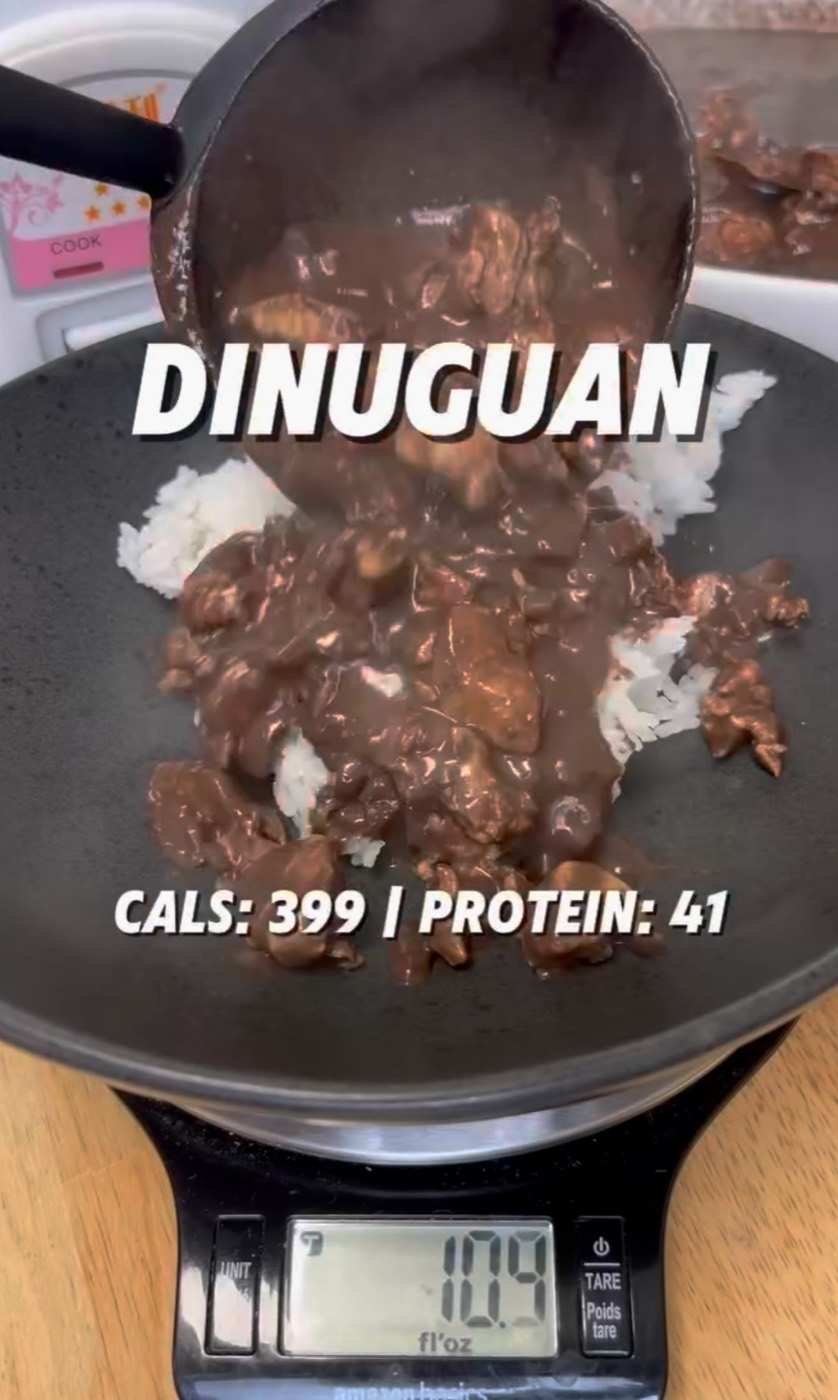
Batch recipe: 3 pounds boneless skinless chicken thigh, 1 cup low-sodium soy sauce, 1/2 cup white or cane vinegar, 8 cloves garlic smashed, 3 bay leaves, 1 tablespoon whole peppercorns, 1 cup water. Brown the chicken lightly in a tablespoon of oil, add everything else, bring to a boil uncovered for 5 minutes without stirring (this keeps the vinegar from turning bitter), then simmer covered for 25–30 minutes until the chicken is fork-tender and the sauce has reduced by half.
Per 6-ounce cooked serving, this runs approximately 260 calories, 35 grams of protein, 10 grams of fat, and 3 grams of carbs. That's roughly 9 servings from 3 pounds of raw chicken thigh, which covers three dinners for a family of three or nine solo lunches for meal prep.
Two swaps worth knowing: pork shoulder adobo runs closer to 320 calories and 28 grams of protein per 6 ounces because of the higher fat content, so it's a better fit on higher-calorie training days. And if you're cutting hard, using low-sodium soy sauce and skipping the pan-frying step in oil shaves another 40–50 calories per serving without changing the flavor most people notice.
Sinigang as Your Fat-Loss Secret Weapon for Volume Eating
Sinigang is the most underrated fat-loss tool in Filipino cooking because it's a volume food — a big bowl of broth and vegetables with a moderate amount of protein, which fills the stomach for very few calories per ounce. That matters more than most macro spreadsheets give it credit for; feeling physically full on a deficit is what keeps people compliant past week three.
Build it with shrimp or pork tenderloin instead of pork belly, short rib, or bangus belly, which run 2–3 times the fat content per ounce. Load the pot generously with radish, string beans, eggplant, tomato, and kangkong or water spinach at the end. The tamarind base itself is essentially calorie-free — the sourness comes from acid, not sugar or fat.
A shrimp sinigang bowl (about 5 ounces of shrimp plus a generous cup and a half of vegetables and broth) runs roughly 180–220 calories with 24–28 grams of protein. Add a soft-boiled egg to the bowl and you're at 35 grams of protein for under 300 calories, before rice.
Batch recipe for 6–8 servings: 2 pounds shrimp or pork tenderloin, 1 packet or 2 cups fresh tamarind broth base, 2 radishes sliced, 1 pound string beans cut into 2-inch pieces, 1 eggplant sliced, 2 tomatoes quartered, a bundle of kangkong added in the last 2 minutes of cooking. Keep the protein and vegetables in a separate container from the broth if you're prepping more than 3 days out, so the vegetables don't overcook when reheated.
Rice Portioning and Smart Swaps
Buy a set of measuring cups if you don't already own one, and use it every time you rice yourself up for the first three weeks of this plan. A leveled cup of cooked jasmine or medium-grain white rice runs about 205 calories, 45 grams of carbs, and 4 grams of protein, based on USDA FoodData Central values.
For most people in a 300–500 calorie deficit, 1 to 1.5 cups of rice per meal fits the budget across 3 meals a day without starving your training performance. The overshoot almost always happens at dinner, when the rice cooker is sitting right there and a second scoop takes zero effort.
A few swaps that make a real dent without feeling like punishment:
None of these swaps matter as much as simply measuring. I've had more success with clients who kept white rice and measured it than with clients who switched to cauliflower rice and kept eyeballing the scoop.
Batch Cooking Logistics: Containers, Timing, and Reheating
Sunday is prep day for most of my clients, with a smaller Wednesday touch-up for anything that doesn't hold past 4 days. Cook the adobo and sinigang proteins first since they take the longest, then rice, then vegetables last if they're going in fresh.
Use glass containers with separate compartments if you can, or at minimum keep sauce-heavy dishes like adobo in their own container so the sauce doesn't turn your rice mushy by day 3. Portion by weight, not by eye — a kitchen scale set to grams makes hitting a 6-ounce (170-gram) protein portion consistent across all 9–10 containers instead of the first three being generous and the last three being short.
Reheating matters more than people expect. Adobo actually improves after a day or two in the fridge as the sauce penetrates the meat further, so it reheats well in a microwave for 90 seconds or on the stovetop with a splash of water to loosen the sauce. Sinigang broth separates slightly when refrigerated — give it a stir when reheating and it comes back together fine.
Freeze what you won't eat within 5 days. Both adobo and sinigang protein (without the leafy greens) freeze well for up to 3 months in a sealed container. Add fresh kangkong or pechay after thawing rather than freezing it with the broth, since leafy greens turn to mush after a freeze-thaw cycle.
The Full 7-Day Meal Plan Breakdown
Here's how the framework plays out across a real week for someone targeting roughly 2,400 calories and 170 grams of protein a day, built from a 400-calorie deficit off an estimated 2,800-calorie maintenance:
Across the week, this lands around 16,800 calories total and roughly 1,190 grams of protein — right at the 170-gram daily target — without a single meal that isn't recognizably Filipino food someone's lola would approve of.
Common Mistakes That Stall Filipino Meal Preppers
The most common mistake is cooking the adobo sauce down too far, which concentrates the soy sauce and pushes sodium and sugar content up if you're using a sweetened soy sauce brand. Use low-sodium soy sauce and taste before adding any sugar or banana ketchup to the braise — a lot of adobo recipes online add more sugar than the dish needs.
The second mistake is skipping vegetables because they don't reheat as cleanly as the protein. This cuts fiber intake, which hurts satiety and, over weeks, makes the whole plan harder to stick to. Prep vegetables twice a week instead of once if that's what it takes to keep them fresh.
The third mistake is treating lechon kawali, crispy pata, or deep-fried dishes as off-limits entirely and then binging on them at a family event because the restriction built up pressure. Better approach: schedule one higher-calorie Filipino meal per week (like the Saturday flex slot above) so it's part of the plan instead of a cheat that derails it.
The fourth mistake is not tracking for long enough to build an accurate mental model of portions. Most people need 3–4 weeks of actually weighing food before they can eyeball a 6-ounce protein portion or a 1-cup rice serving accurately. Skipping that step and eyeballing from day one is why a lot of home cooks think they're in a deficit when they're actually eating at maintenance.
Pairing Your Meal Prep With Training for Recomposition
Body recomposition — losing fat while holding or building muscle — needs a training stimulus, not just a calorie deficit and protein target. The American College of Sports Medicine's guidance on exercise and weight management points to resistance training as the piece that protects lean mass while calories are down, which is exactly what separates recomposition from simple weight loss.
For Marco, we ran 3 full-body resistance sessions a week — squat or leg press, a horizontal push and pull, a vertical push and pull, and direct arm work — while keeping the meal prep steady. The extra rice on Saturday's flex day lined up with his heaviest training day of the week, which is a simple way to use carbs functionally instead of cutting them uniformly across every day.
On training days, I'll often add the extra half-cup of rice to the post-workout meal specifically, since that's when the body partitions carbohydrate toward glycogen replenishment most efficiently. On rest days, sticking closer to the 1-cup baseline keeps total weekly calories in line with the deficit.
The protein targets in this article don't change based on training or rest days — 170 grams stays 170 grams regardless. What shifts is where the carbs land. That's a small adjustment, but it's the difference between a meal prep that supports training and one that just restricts calories.
Your Action Step for This Week
Don't overhaul your whole diet this week. Pick one thing: buy a $10 set of measuring cups, and for every meal with rice, level off exactly 1 cup instead of scooping freehand. Keep the adobo, keep the sinigang, keep the rest of your week exactly as it is. Track your weight and how your clothes fit for 7 days. For most people, that single change — the rice scoop, not the recipe — is where the first few pounds come off.
Can you lose fat eating Filipino food every day?
Yes. Filipino ulam like adobo, sinigang, and inihaw are naturally protein-forward and low in added sugar. Fat loss comes down to total calories and protein intake, and the biggest lever in a Filipino meal is rice portion size, not the meat or the sauce.
How much rice can I eat and still lose fat?
A leveled cup of cooked white rice is about 205 calories and 45 grams of carbs. Most people cutting can fit 1–1.5 cups per meal into a 300–500 calorie daily deficit, depending on total calorie target and activity level. The mistake is the 2–2.5 cup mound, not rice itself.
Is chicken adobo good for muscle gain?
Yes. A 6-ounce serving of boneless skinless chicken thigh adobo delivers roughly 33–35 grams of protein with minimal added carbs from the soy-vinegar braise. That's enough protein per meal to support muscle protein synthesis per the per-meal thresholds studied by Schoenfeld and Aragon.
What's a low-calorie version of sinigang?
Use shrimp or pork tenderloin instead of pork belly or short rib, skip or go light on the oil at the start, and load the pot with radish, string beans, eggplant, and kangkong. A shrimp sinigang bowl can run about 180–220 calories with 24–28 grams of protein.
How many meals should I meal prep for a week of Filipino food?
Most people do best prepping protein and sauce in three large batches (roughly 8–10 servings each) and rice separately in 1-cup portions. That covers 3 meals a day for 7 days with two ulam rotating, so you're not eating the exact same dish twice in a row.
Do I need to weigh my food to make this work?
For the first 2–3 weeks, yes — at least the protein and rice. A kitchen scale takes the guesswork out of what '6 ounces' or '1 cup' actually looks like in your own bowl. After that, most clients can eyeball it accurately.